Say it, then stop one word early.
These were written to be spoken before they were written to be read, so reading them out loud is the intended way round rather than a compromise. Four things make it work.
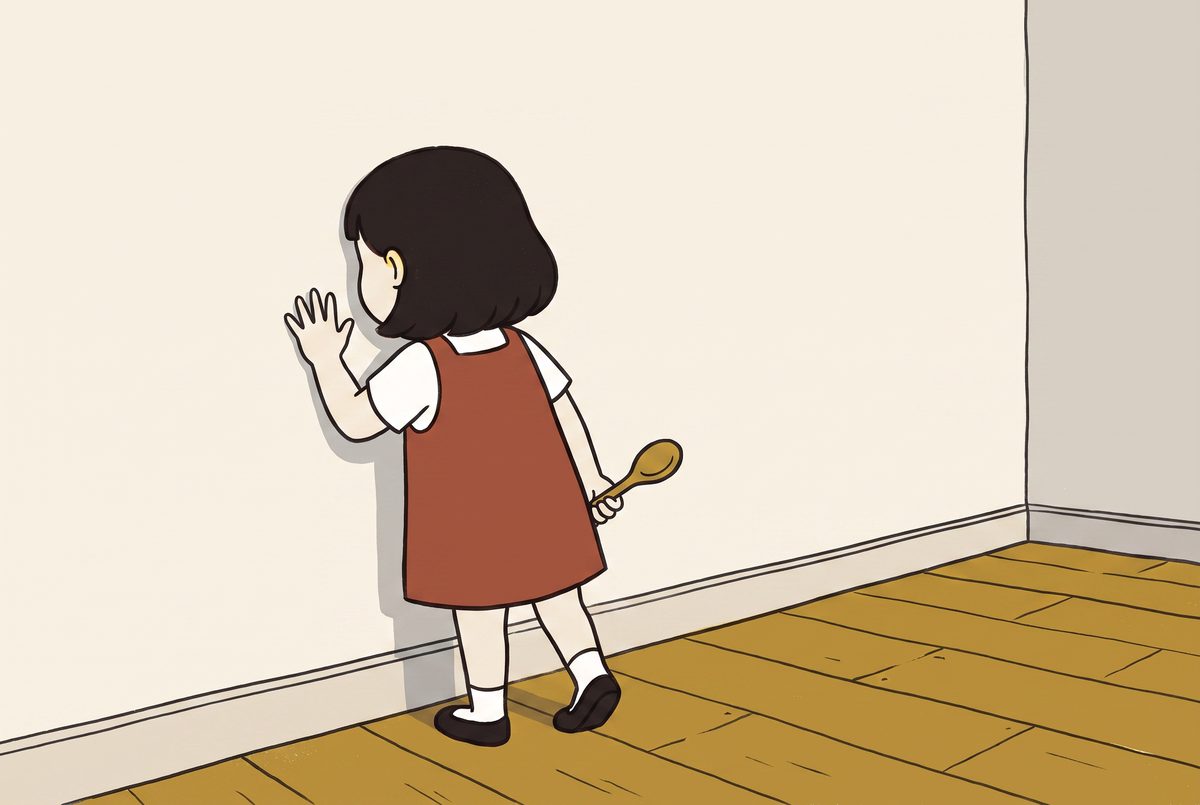
Leave the gap.
The refrain comes back three times, and once more changed at the turn. Say it, stop one word short, and wait. The silence is doing the work — it is the same silence the two taps ask for.
Say the noises.
The building's lines are set heavier on the page for exactly this reason. There is one in every story and it is always the hinge of it.
Do not explain it.
Nobody ever tells Pim whether the building really answered. Leaving that open is the point, and a child who asks has understood the book.
End with the taps.
Two taps on the nearest hard thing, and wait. Someone else gets to be the building. This is the bit that leaves the book and goes into the supermarket queue.
Where you are in the story, at any moment.
Eight beats, the same order, all fifty-two times. Useful for you; essential for the three-year-old who wants to know what happens next and already does.
1. Hook
Pim is already moving by the eighth word.
2. Want
What she is after, and the fixed fact standing in the way.
3. Try one
The rule, said out loud, and the first honest attempt.
4. Try two
Somebody else has a go, usually worse and much louder.
5. Turn
The building does something nobody expected.
6. Reverse
Pim goes back over it in her head and hears what it meant.
7. Settle
Who won, who lost, and the tapper goes on the board.
8. Close
Two taps, and wait for the tock.
The 8 built for the end of the day.
They invert the arc: no crisis, nobody loses, and the progress chant runs backwards.
 9One GrateSoft on the stone, and loud on the grate.
The rain sounds one way on everything in the Middle and another way on one thing, and you win when you find the one thing.
 18One PullOne pull. Then call it wet or dry.
Give the line one pull, call it wet or dry, then go up and see if you were right.
 25One ClunkTogether, and the door goes clunk.
Push and lift at the very same moment and the green door says one clunk instead of a rattle.
 30One In TwelveOne in twelve. One forgets the lift.
Eleven people do a push and a lift. Catch the one who only shoves, and that one is yours to name.
 36Long RingRun the spoon down. The long one's mine.
Run the spoon along the hooks in the dark and take down the one that keeps ringing, because that one is yours.
 42Painted DoorKnock with your knuckle. Lean with your knee.
The small door is painted shut and it only ever goes THUD — I have to make it say a knock instead, with my knee on it and one knuckle.
 47Every PigeonNo hands. Make the whole roof go up.
Pigeons go all at once or not at all — so I have to make every single one of them go up, on purpose, without touching one.
 51One StoneEvery stone gives it back but one.
Every stone in the Middle throws your last word back at you — except one, and I have to walk on all of them until I find the one that keeps it.
Reading them out loud.
How do you read a Tocko story out loud?
Slowly, and stop early. Every story has one line that comes back three times — say it and stop one word before the end, and wait. The child fills it in. That is the whole technique.
How long does a Tocko story take to read aloud?
About 8 minutes at an unhurried pace. A whole book of thirteen is roughly 104 minutes.
What is the two taps game?
Every story ends the same way: tap twice on the nearest hard thing, then stop and wait. It has two roles, which is why it travels — one child taps and waits, and somebody else is the building and answers. It works in a supermarket queue and through a closed door, and a two-year-old with no words at all can play it.
What do I do with the noises?
Say them. They are set in a heavier face on the page so you can see them coming. A knock, a hum, a bin lid — the child will be saying them with you by the third story.
Which ones are right for bedtime?
The 8 Quiet Stories. No crisis, nobody loses, and the progress chant runs backwards so the story gets slower rather than faster.