One small fact.
A whole new game.
The house supplies a sound. Pim supplies a rule. Change either one below and see how a Tocko story begins.
House soundscape Off
Find a fixed fact
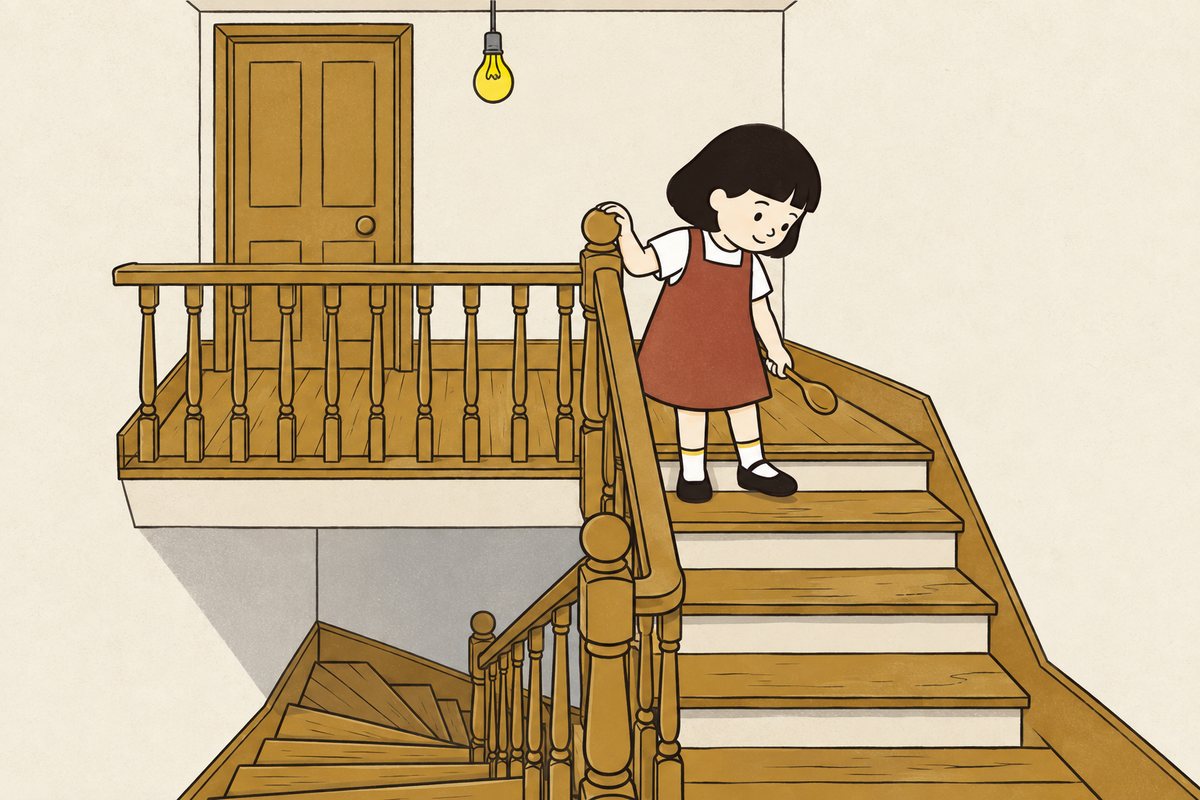 The Stairs
The eleventh stair squeaks. It has always squeaked.
The building keeps doing this. It cannot change its mind.Give it a rule
Don't wake it
Silence
A game to play

Eleventh Stair
You have to get all the way up to Number Three, and if the eleventh stair squeaks you go back to the bottom and start again.
“Squeak, and you're back at the bottom stair.”
Explore this illustrated story28 facts × 8 rules. Some pairings became the 52 stories in the books; the others are still open.
Eight little steps.
One satisfying tock.
Follow Eleventh Stair from the first sound to the final tap. Select a step to see what happens.

Hook
Pim is already moving by the eighth word.
In the tall house Tocko lived Pim — and Pim ran in with the bread bag, straight for the stairs.From Eleventh Stair · story 2
Want
What she is after, and the fixed fact standing in the way.
Pim wanted to carry the bread up, all the way up, and open the bag herself. Nobody was going to open that bag, not without Pim.From Eleventh Stair · story 2
Try one
The rule, said out loud, and the first honest attempt.
Pim went up slow, and slow was hard. One stair, and two stairs, and three, and four, five, six.From Eleventh Stair · story 2
Try two
Somebody else has a go, usually worse and much louder.
Pim said, "Slow. You have to go slow, or you go back down." Hod from upstairs went up fast. His shoe hit each stair, and he knew it.From Eleventh Stair · story 2
Turn
The building does something nobody expected.
So Pim said, "Do it again, and I will listen." Hod from upstairs said, "Right, so. Watch this one."From Eleventh Stair · story 2
Reverse
Pim goes back over it in her head and hears what it meant.
Pim went back down the stairs in her head. Hod from upstairs, slow on the eleventh. KRRAWWW-nk-nk-NGGG, and it did not stop.From Eleventh Stair · story 2
Settle
Who won, who lost, and the tapper goes on the board.
Hall. Green door. Roof. Home. Then Pim said, "Hold the bread, and I will run."From Eleventh Stair · story 2
Close
Two taps, and wait for the tock.
Two taps, and Tocko tapped back. Tock, tock.From Eleventh Stair · story 2
A new sound opens
8 new possibilities.
Keep the same eight rules. Imagine discovering one more fact about the house, and watch the possibilities grow.
The current fact log: 28 facts, 224 pairings.
This is a what-if experiment. The published collection still contains 52 stories.
Explore all 224 pairings
Every square is a story that could exist.
28 fixed facts about one building, crossed with 8 kinds of rule a four-year-old invents. That is 224 games before anybody finds a new fact — and every story finds one. 52 cells are spent.
The 28 facts, room by room
How it works.
How are Tocko stories written?
One fixed fact about the building is crossed with one of eight rule-types a small child actually invents. The pairing is the game; the game is the story. There are 28 facts and 8 rule-types on the board, which is 224 pairings.
Why does every story have the same eight beats?
So a child who has heard three of them knows where they are in the fourth, and can join in. The shape is fixed and the fact is fixed; the only variable is the rule Pim invents.
Is the building magic?
No, and this is the load-bearing rule. Tocko creaks, ticks, drips and bangs exactly as much as a real old building does. Pim decides those noises are answers. The book never says whether she is right.
Will there be more?
No, and the arithmetic is published. There are 28 fixed facts and 8 rule-types, which is 224 cells before a single new fact is found. One new fact is found per story, so the grid grows eight times faster than it is spent. 52 of the 224 cells are used.